How to Identify This Tree: The Complete Guide to Tree Identification for Every Season
Why Learning to Identify This Tree Matters More Than You Think
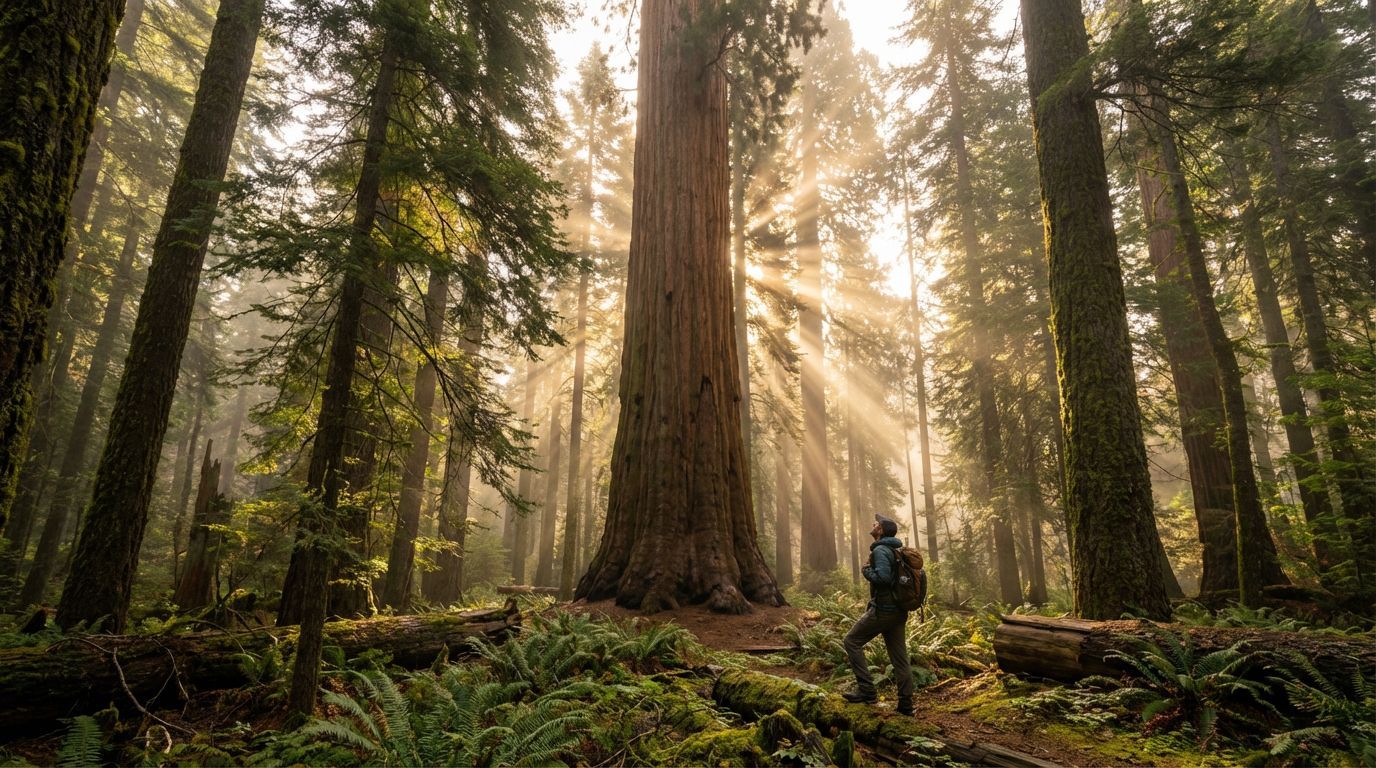
Whether you are standing in your backyard staring at an unfamiliar silhouette or hiking through a forest trail surrounded by towering canopies, the ability to identify this tree in front of you is a skill that opens up an entirely new relationship with the natural world. Tree identification is not just a hobby for botanists and naturalists — it is a practical life skill with real-world applications. Knowing the species of a tree in your yard can help you understand whether its roots might threaten your home's foundation, whether its berries are safe for children to touch, or whether it is protected by local conservation laws. Beyond the practical benefits, identifying trees enriches your experience outdoors, deepens your appreciation for biodiversity, and even connects you to centuries of ecological and cultural history. In a world where biodiversity is under increasing pressure, people who can identify trees become stewards of the environment. Every correctly identified tree adds to citizen science databases, helps ecologists track species migration due to climate change, and supports conservation planning. This guide will walk you through every method available to help you identify this tree — from old-school field techniques to cutting-edge artificial intelligence apps — so that you always have the right tool for the job, no matter where you are.
The Classic Method: Using Leaves to Identify This Tree
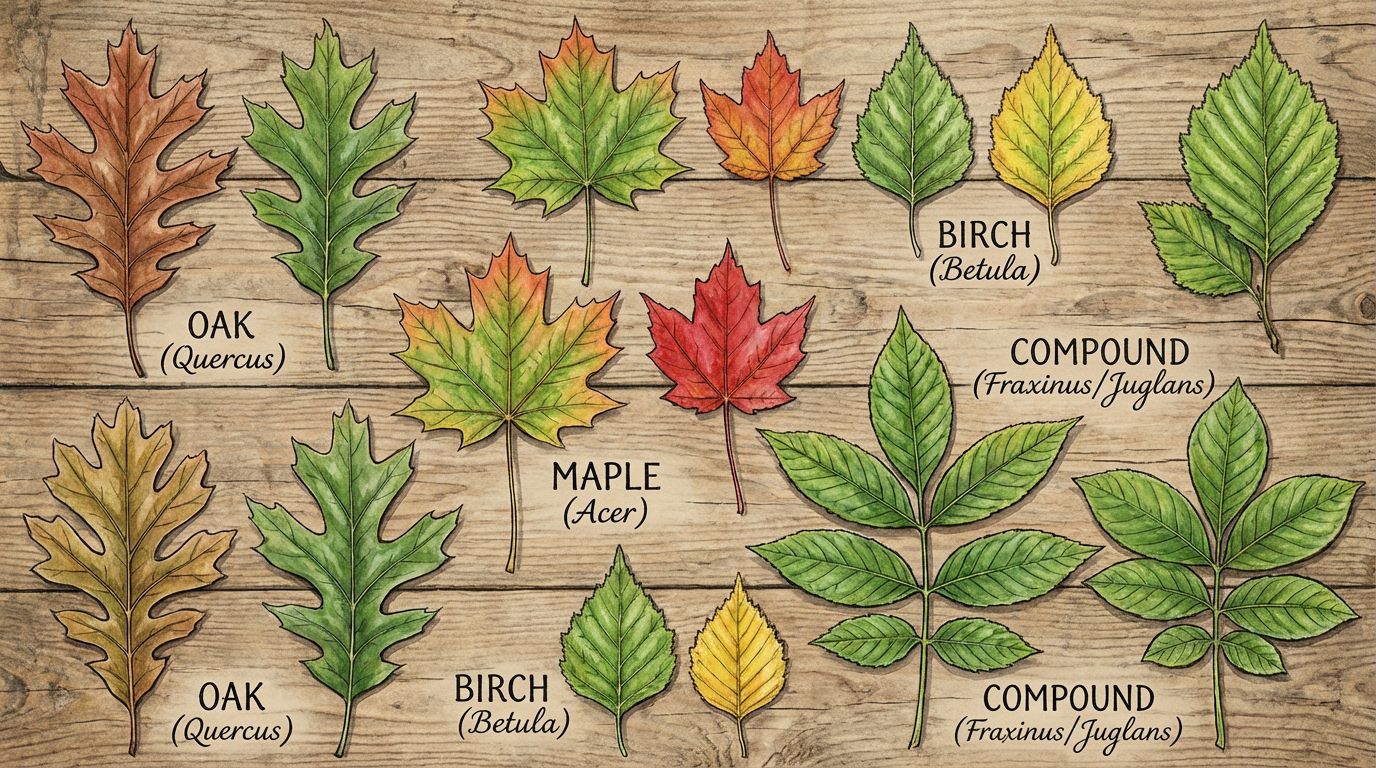
Leaves are arguably the single most reliable feature you can use when you want to identify this tree, and for good reason — they are usually abundant, easy to examine, and packed with identifying information. Start by looking at the leaf shape. Is it simple, meaning one single leaf blade, or compound, meaning multiple leaflets attached to a single stem? A compound leaf with five leaflets arranged like fingers on a hand points you toward species like the horse chestnut or buckeye, while a compound leaf with paired leaflets along a central stem suggests species like ash, walnut, or honey locust. Next, examine the leaf margins, which are the edges of the leaf. Are they smooth and entire, gently wavy, finely toothed like a serrated knife, or deeply lobed like those of an oak? The lobing pattern of oak leaves alone varies dramatically between species — white oak leaves have rounded lobes while red oak leaves have pointed, bristle-tipped lobes. Venation, or the pattern of veins inside the leaf, also matters. Pinnate venation means one main vein runs from the stem to the tip with smaller veins branching off the sides, like in a cherry or birch. Palmate venation means several main veins radiate outward from a central point, like in a maple. Do not forget leaf texture. Is it waxy and smooth, like a magnolia? Soft and fuzzy, like a mullein? Stiff and leathery? Finally, smell the crushed leaf — sassafras smells like root beer, black walnut has a distinctive spicy aroma, and eucalyptus has that unmistakable medicinal quality. Taking all of these features together gives you a highly accurate profile that narrows your identification significantly.
Bark, Branches, and Buds: Beyond the Leaf to Identify This Tree
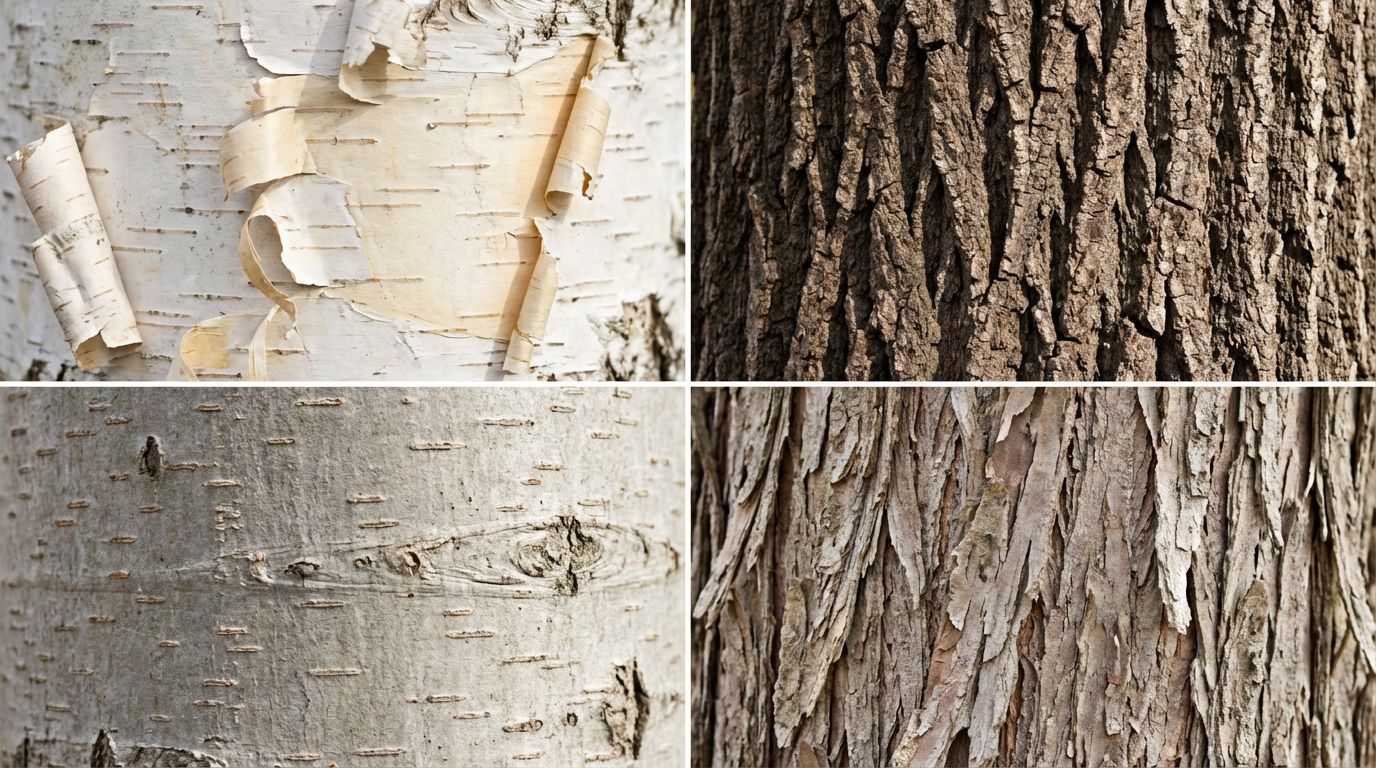
Leaves are not always available. In winter, deciduous trees drop them entirely, and sometimes you encounter a fallen branch or a photograph taken in poor lighting where leaf detail is hard to see. That is why knowing how to use bark, branches, and buds to identify this tree is absolutely essential for year-round accuracy. Bark is one of the most overlooked identification tools, yet it tells a fascinating story. Young trees often have smooth bark that becomes more textured and furrowed with age, but the pattern of that texture is species-specific. Beech trees, for example, maintain that smooth, gray, elephant-skin bark even in old age, while mature white ash develops a distinctive interlacing, diamond-shaped ridge pattern. Paper birch is instantly recognizable by its bright white, peeling bark. Shagbark hickory has long, curved plates of bark that peel away from the trunk in dramatic fashion. Sycamore trees reveal a beautiful patchwork of cream, tan, and olive as sections of outer bark flake away. Branches and their arrangement also help. Are the branches arranged opposite each other on the twig — meaning two branches emerge at the same point directly across from one another — or are they alternate, staggering along the branch? The acronym MAD Horse is often used by naturalists: Maple, Ash, Dogwood, and Horse chestnut are the main trees with opposite branching. Nearly all other common trees have alternate branching. Buds in winter are equally telling — the terminal bud of a beech is long and lance-like, while the flower buds of a magnolia are large, furry, and unmistakable. By training your eye to read all of these features together, you can confidently identify this tree even when it stands bare against a winter sky.
Seeds, Fruits, and Flowers: Nature's Most Distinctive Clues
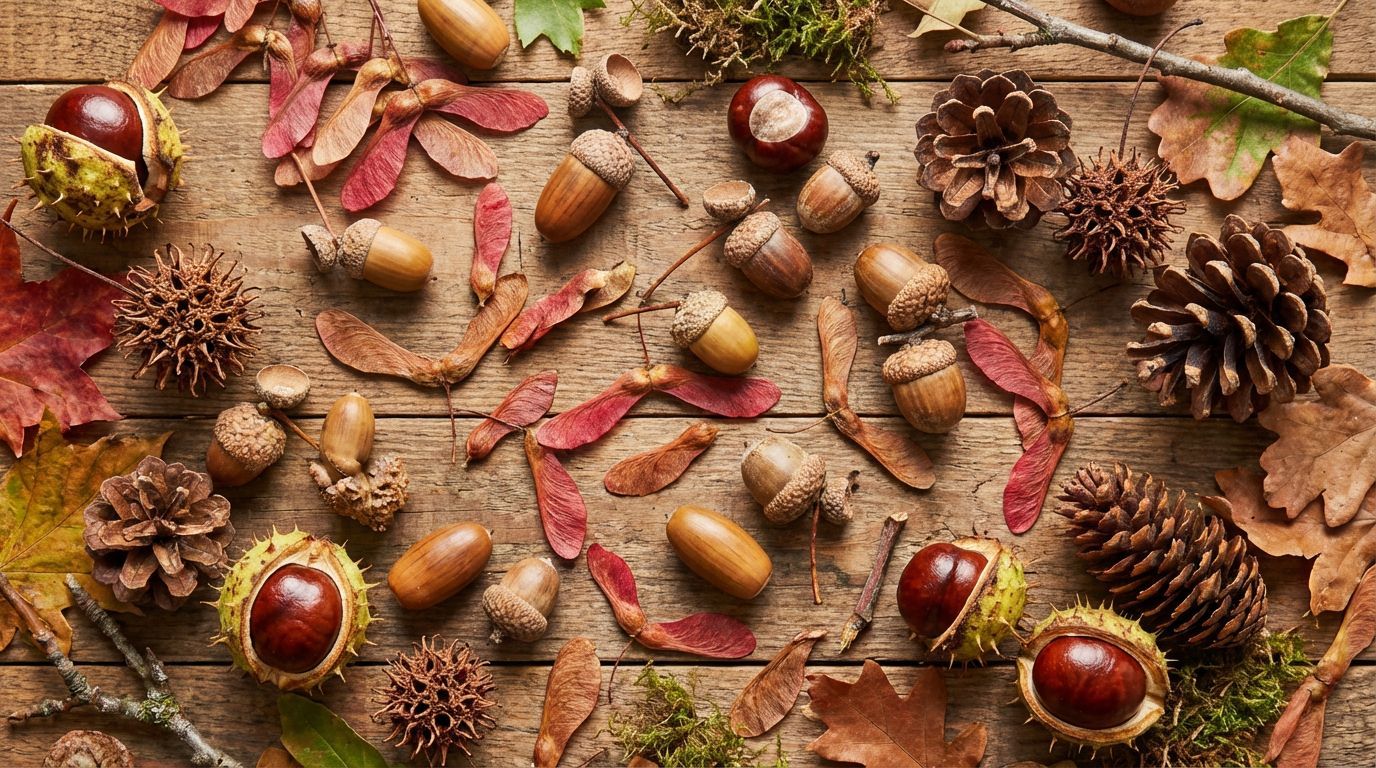
If you want to identify this tree with a high degree of certainty, and you happen to be visiting in the right season, then seeds, fruits, and flowers will often give you the most definitive answer of all. Fruits and seeds are the tree's reproductive output, and natural selection has crafted them into wonderfully distinct forms. The winged samaras of maple trees — those spinning helicopter seeds beloved by children everywhere — are unlike anything else. The spiky green balls of a sweet gum tree litter the ground with their hard, star-shaped seed capsules. The elongated, twisted seed pods of a honey locust dangle from branches in late summer. Acorns immediately tell you that you are dealing with an oak, but the size, shape, and cap texture of the acorn further refine the species. White oak acorns have a warty cap covering about a quarter of the nut, while bur oak acorns have a deeply fringed, mossy cap that nearly encloses the nut entirely. Flowers are equally diagnostic, though they are only present for a short window in spring for most species. The large, showy, tulip-shaped flowers of the tulip poplar are unmistakable. Serviceberry trees produce delicate clusters of white five-petaled flowers in early spring before most other trees leaf out. Catalpa trees produce orchid-like white flowers with purple and yellow markings. Redbud trees burst into striking magenta-pink blooms directly on their bark before leaves appear, a botanical phenomenon called cauliflory. Collecting a small sample of fruit, seed, or flower — where it is legal and ethical to do so — and cross-referencing it with a field guide or tree identification app dramatically speeds up the process and boosts your confidence in a final answer.
Use Technology: The Best App to Identify This Tree Instantly
Technology has genuinely transformed the way people identify trees, and if you want the fastest and most accurate results, a dedicated tree identification app is your best friend. The team at IdentifyThis.app has built a powerful, user-friendly tool specifically designed for this purpose. You can visit the full feature breakdown at identifythis.app/identify-this-tree-app to see exactly what makes it stand out from the crowd. The app uses advanced artificial intelligence and machine learning trained on tens of thousands of verified tree images to give you near-instant identifications from a single photograph. Simply open the app, point your camera at the leaf, bark, fruit, or overall tree form, and within seconds you receive a species identification complete with common name, scientific name, key identifying features, and ecological information. What makes IdentifyThis.app particularly valuable is its contextual awareness — it considers your geographic location when narrowing down possibilities, which dramatically reduces the chance of a false positive. If you are in the southeastern United States photographing a flowering tree in spring, the app weighs local species distributions accordingly. The app also allows you to build a personal tree journal, saving your identifications with GPS coordinates and photos so you can track the trees you have discovered over time. For educators, this makes it an incredible classroom tool for outdoor learning. For homeowners, it becomes a practical reference library for every tree on your property. The app works on both iOS and Android and is designed to function even in areas with limited connectivity, making it reliable on remote hiking trails. Whether you are a curious beginner or an experienced naturalist looking for a second opinion, IdentifyThis.app delivers the answers you need to identify this tree quickly, accurately, and enjoyably.
Regional Differences: How Geography Changes the Way You Identify This Tree
One of the most important and often overlooked factors in tree identification is geography. The same strategy you use to identify this tree in a New England autumn forest will need adjustment when you are walking through a Pacific Northwest old-growth forest, a Southern swamp, or a Great Plains windbreak. Understanding regional tree communities gives you a tremendous head start because it dramatically narrows the list of possible species you are looking at. In the northeastern United States and southeastern Canada, the dominant forest is the temperate deciduous forest characterized by species like sugar maple, American beech, yellow birch, red oak, white oak, and eastern white pine. If you encounter a large, five-needled pine in this region, it is almost certainly eastern white pine. In the Pacific Northwest, the towering conifers dominate — Douglas fir, western red cedar, Sitka spruce, and western hemlock define the landscape. A Douglas fir is identifiable by its distinctive cones, which have three-pronged bracts poking out between each scale, resembling the tail and hind legs of a mouse hiding inside. In the American South, you encounter a fascinating mix of subtropical and temperate species — live oaks draped in Spanish moss, bald cypress standing in swamps with their distinctive knobby knees, and longleaf pine savannas. The Great Plains present their own unique challenge because trees are naturally sparse and the ones present are often near water sources or planted as windbreaks. Cottonwoods and willows line river courses, while introduced species like Osage orange and green ash appear in farm country. International travelers face even greater variation — eucalyptus dominates much of Australia, baobabs define the African savanna skyline, and tropical rainforests in Southeast Asia contain staggering species diversity that challenges even expert botanists. Always start your identification attempt with a clear sense of your geographic region, as this single factor will make every other clue easier to interpret.
Common Mistakes People Make When They Try to Identify This Tree
Even well-intentioned nature enthusiasts fall into predictable traps when trying to identify this tree, and understanding these common errors will save you a great deal of frustration and prevent potentially dangerous misidentifications. The first and most common mistake is relying on a single feature in isolation. Seeing a tree with white bark and immediately concluding it must be a paper birch, for example, ignores the fact that several other species including gray birch, quaking aspen, and even young sycamores can display similarly light-colored bark. Always cross-reference at least three or four features before committing to an identification. The second mistake is ignoring the juvenile versus mature distinction. Many trees look dramatically different at different life stages. A young white oak with its deeply lobed leaves might be confused with a red oak, but an old white oak develops a rounder crown and more rounded leaf lobes that become more distinctive with age. Similarly, smooth juvenile bark tells you very little — always try to examine the trunk of a mature individual for the most reliable bark characteristics. Third, many beginners confuse leaves with leaflets. When examining a compound leaf like that of a black walnut, it is tempting to mistake each individual leaflet for a separate leaf. The key is to look for the bud — buds only form at the base of a true leaf petiole, not at the base of individual leaflets. Fourth, do not rely solely on photographs found through a reverse image search on the internet, as these can be mislabeled or show trees from different continents than your own. Always use region-specific resources. Finally, never taste or handle tree parts without confirmed identification, particularly berries, seeds, and sap — many common trees including yew, water hemlock, and manchineel have parts that are dangerously toxic. Using a reliable app like IdentifyThis.app alongside a regional field guide gives you the redundancy needed to make safe, confident identifications every time.
Try It Now on IdentifyThis.app
Use our free AI-powered tool to identify this tree instantly.
Try Free NowFrequently Asked Questions
What is the easiest way to identify this tree using just my phone?
The easiest way to identify a tree using your phone is to download a dedicated AI-powered tree identification app like the one available at identifythis.app/identify-this-tree-app. Simply take a clear, well-lit photograph of the most distinctive feature available — ideally a leaf, but bark, fruit, or seeds also work well — and let the app's machine learning algorithm compare your image against its database of thousands of verified tree species. For best results, photograph the feature against a plain, contrasting background, make sure the image is in sharp focus, and if possible take multiple photos from different angles. The app will return a species identification in seconds along with supporting information to help you verify the result.
How do I identify this tree in winter when there are no leaves?
Identifying a deciduous tree in winter is entirely possible by focusing on the features that remain visible year-round. Start with bark texture and color, which are highly species-specific — shagbark hickory, paper birch, beech, and sycamore are all instantly recognizable by bark alone. Next examine the winter buds, which vary dramatically between species in size, color, texture, and arrangement. Notice whether the buds are opposite each other on the twig or alternate — opposite budding is found in maples, ashes, dogwoods, and horse chestnuts, while almost all other common trees have alternate buds. Look also at persistent fruits or seed structures that remain on branches through winter, such as the seed balls of sweet gum, the papery samaras of ash, or the dried cones of conifers. The overall form and branching structure of the tree against a winter sky can also be quite diagnostic once you have trained your eye.
Can I identify this tree by its bark alone?
Yes, bark alone can be sufficient to identify many common tree species, especially mature specimens. Bark identification is most reliable for trees with highly distinctive bark characteristics. White and paper birch have that famous peeling white bark. Shagbark hickory has long, loose, curved plates that peel dramatically away from the trunk. American beech maintains smooth, gray bark that resembles elephant skin throughout its life. Sycamore displays a beautiful camouflage pattern of cream, tan, and green as outer bark flakes away. Mature white ash has interlacing diamond-shaped ridges. Black cherry has distinctive dark, broken, scaly bark often described as resembling burnt potato chips. For younger trees or species with more generic gray-brown furrowed bark, bark alone may not be enough and you should combine it with other features like bud arrangement, overall tree form, and any persistent fruits or seeds.
How do I tell the difference between similar-looking trees when I try to identify this tree?
Distinguishing between similar species — what botanists call look-alikes — requires careful attention to multiple features simultaneously rather than relying on any single characteristic. For example, to tell apart red oak and pin oak, look at the leaf shape: pin oak has deeply cut sinuses between lobes that nearly reach the midrib, while red oak has shallower sinuses. Also examine how lower branches grow — pin oak's lower branches tend to droop downward distinctively. To separate sugar maple from Norway maple, scratch the leaf stem: sugar maple produces clear sap while Norway maple produces a milky white latex. Using a tree identification app with location awareness helps enormously because it filters possibilities by species known to occur in your specific region, reducing the chance of confusing a North American species with a visually similar European or Asian one. Always consult multiple references when in doubt.
Is it safe to eat berries or fruit from a tree I am trying to identify?
Absolutely never consume any part of a tree — including berries, fruits, seeds, leaves, or sap — until you have a confirmed, verified identification from multiple reliable sources. Many common trees produce fruits that are toxic to humans, and visual similarity to edible species can be dangerously misleading. Yew trees, for example, produce bright red berries that look appealing but are highly toxic. The seeds inside elderberry fruit are toxic raw but the berries are edible when properly cooked, creating confusion for foragers. Water hemlock is one of the most violently toxic plants in North America. Even the sap of some trees like manchineel can cause severe skin burns. If you are foraging with the intention of eating wild fruits or berries, always cross-reference your identification using at least three independent sources including a regional field guide, a knowledgeable expert, and a reliable identification app, and when in any doubt, leave it alone.