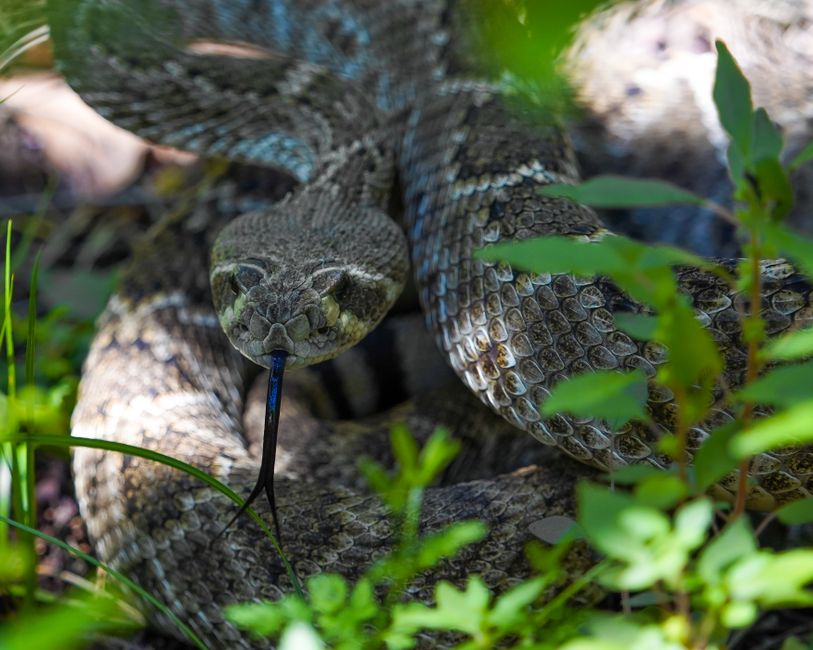
Snakes in Texas: How to Identify Every Species You Might Encounter
Texas is home to 96 snake species — more than almost any other U.S. state — including 4 venomous groups that demand your attention. This guide helps you identify what you just saw, understand the real risk, and know exactly what to do next.
Texas hosts 96 recognized snake species, ranging from the tiny rough earth snake hiding under your garden flagstone to the iconic western diamondback rattlesnake patrolling dry creek beds. Of those, only a handful are genuinely dangerous to humans, but knowing which is which can make a critical difference. Snakes are found in every county across the state — in rural grasslands, suburban backyards, city parks, and remote wilderness. Whether you just startled one on a hiking trail or found one coiled near your back porch, understanding what you're dealing with is the first step to staying safe and making a smart decision.
Texas spans nine distinct ecological regions — from the piney woods of East Texas and the cypress swamps along the Gulf Coast, to the Chihuahuan Desert in the Trans-Pecos, the rolling Hill Country limestone plateaus, and the flat agricultural plains of the Panhandle. Each habitat supports a different community of snakes. Cottonmouths thrive in the slow-moving bayous and swamps of Southeast Texas, while western diamondbacks and prairie rattlesnakes dominate the drier western regions. Corn snakes and eastern hognoses are more at home in sandy East Texas forests. That geographic diversity is exactly why Texas has so many species — and why a one-size-fits-all identification approach doesn't work here.
This guide walks you through the snakes you're most likely to encounter across Texas, starting with the four venomous groups you must know. Each profile includes size, appearance, regional range within the state, and behavior so you can make a confident ID from a safe distance. If you still aren't sure what you saw, upload a photo to our AI snake identifier for an instant, expert-level match. The tool is specifically trained on North American species and can distinguish between look-alikes — like the harmless scarlet kingsnake and the venomous Texas coral snake — in seconds. Knowledge and a clear photo are your two best tools.
Venomous Species to Know
Texas has four venomous snake groups you need to recognize on sight: pit vipers (rattlesnakes, copperheads, and cottonmouths) and the Texas coral snake. All four are present across wide swaths of the state. A correct identification isn't just trivia — it determines whether a bite is a medical emergency requiring antivenom or a painful but less critical wound.
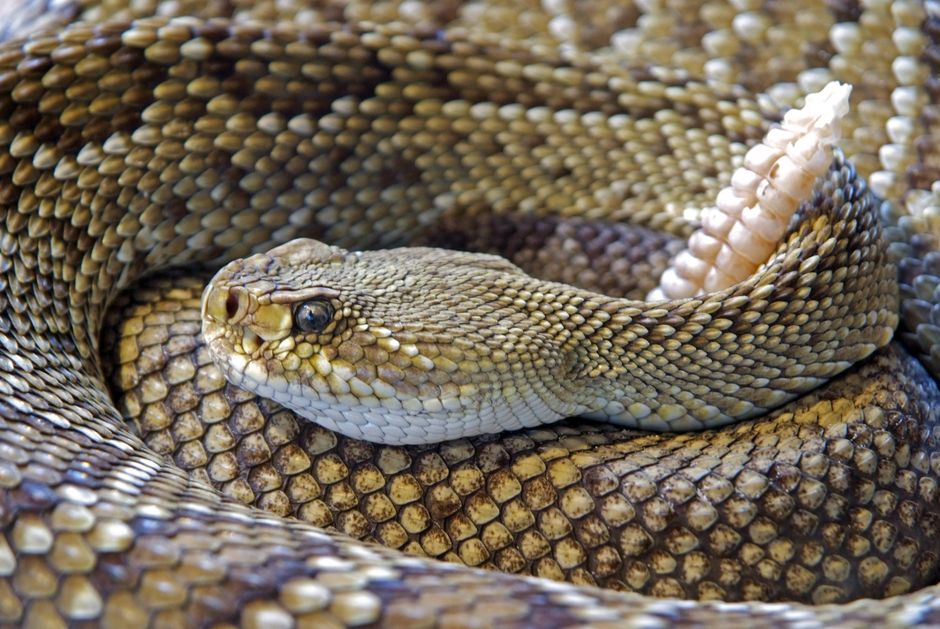
Crotalus atrox
The western diamondback is Texas's most encountered venomous snake and the leading cause of serious snakebite in the state. Adults typically measure 3.5 to 5 feet, with some reaching 7 feet. The body is heavy and gray to brown with clearly defined diamond-shaped dorsal patterns. The tail is banded in black and white immediately before the rattle — a reliable field mark. This species ranges across all of western, central, and southern Texas into the Hill Country and coastal plains. It is bold and slow to retreat, often holding its ground and rattling loudly when threatened. Venom is hemotoxic and can be life-threatening without prompt treatment.
- Black-and-white banded tail before rattle
- Diamond-shaped pattern along back
- Heavy, thick body up to 5+ feet
- Triangular head with heat-sensing pit
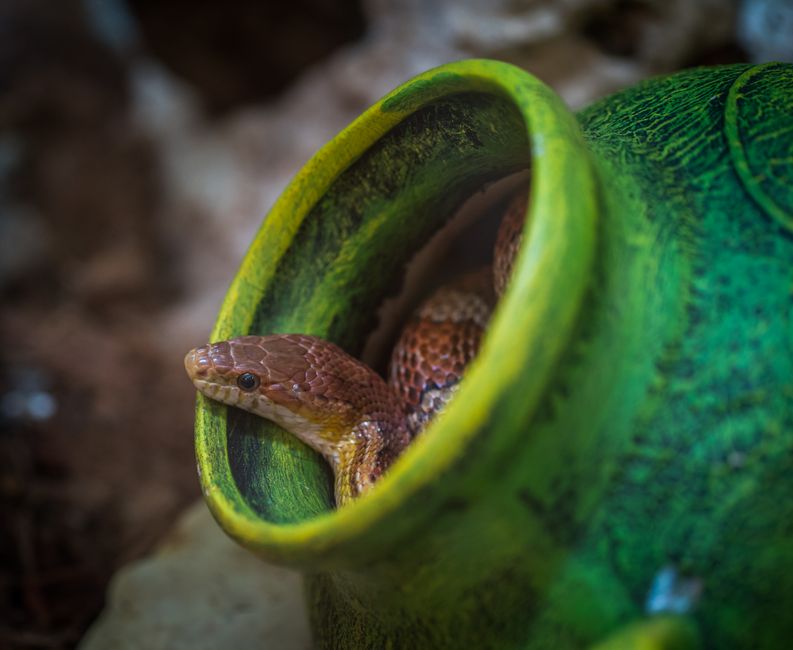
Agkistrodon contortrix
Copperheads are responsible for more snakebites in Texas than any other venomous species, largely because their camouflage is exceptional and they are widespread in suburban and wooded areas. Adults range from 24 to 36 inches. The body is pale tan to pinkish-brown with distinctive hourglass-shaped crossbands that are wider on the sides and narrow at the spine — a pattern unlike any other Texas snake. The head is a solid copper-orange color with no markings. Three subspecies occur in Texas: the broad-banded, the southern, and the Trans-Pecos. Most common in eastern, central, and Hill Country Texas in wooded ravines, rock outcrops, and leaf litter near water.
- Hourglass crossbands, wider at sides
- Solid copper-colored head
- Unmarked pale belly
- Stocky body, 24–36 inches
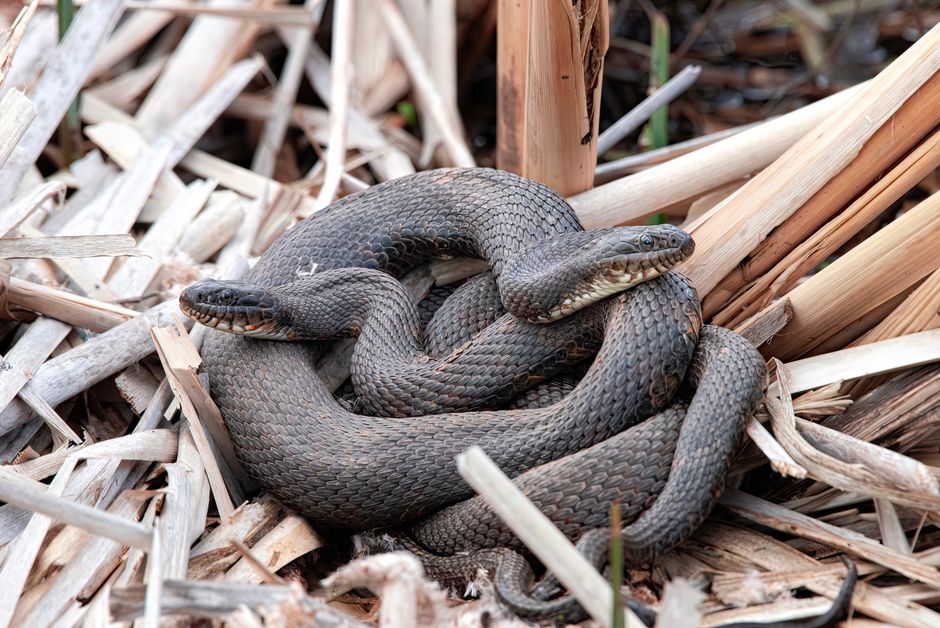
Agkistrodon piscivorus leucostoma
The cottonmouth is a large, semi-aquatic pit viper found throughout East and Southeast Texas, extending into the central part of the state along river corridors. Adults average 2.5 to 4 feet and are heavy-bodied with dark brown, olive, or nearly black coloring, often with faint banding visible on younger individuals. The defining field mark is the threat display: when cornered, cottonmouths gape widely, revealing the bright white interior of the mouth that gives the snake its name. Found in swamps, bayous, lakeshores, slow rivers, and flooded fields. Often confused with the non-venomous banded water snake — look for the cottonmouth's broader, more triangular head and the facial pit between eye and nostril.
- White mouth interior displayed when threatened
- Dark, heavy body — nearly black in adults
- Broad triangular head distinct from neck
- Heat-sensing pit behind nostril
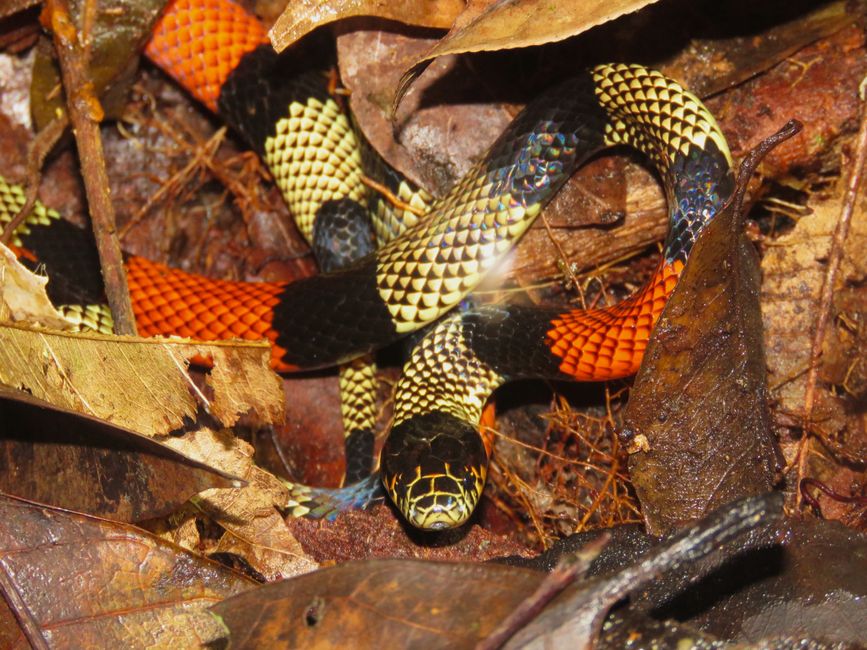
Micrurus tener
The Texas coral snake is the only member of the Elapidae family in the state and delivers a potent neurotoxic venom. Adults are slender and reach 24 to 30 inches. The color pattern is vivid: red, yellow, and black rings encircling the body, with red and yellow bands always touching — the key distinction from harmless mimics like the scarlet kingsnake, where red touches black. The head is entirely black past the yellow collar. Found most commonly in wooded areas, sandy soils, and the leaf litter of East and Central Texas, extending south to the Gulf Coast. Coral snakes are reclusive and bites are rare, but envenomation requires emergency care due to delayed but serious neurological effects.
- Red and yellow bands touch each other
- Entirely black head to yellow collar
- Slender, smooth-scaled body
- Red-yellow-black color sequence
Common Harmless Species
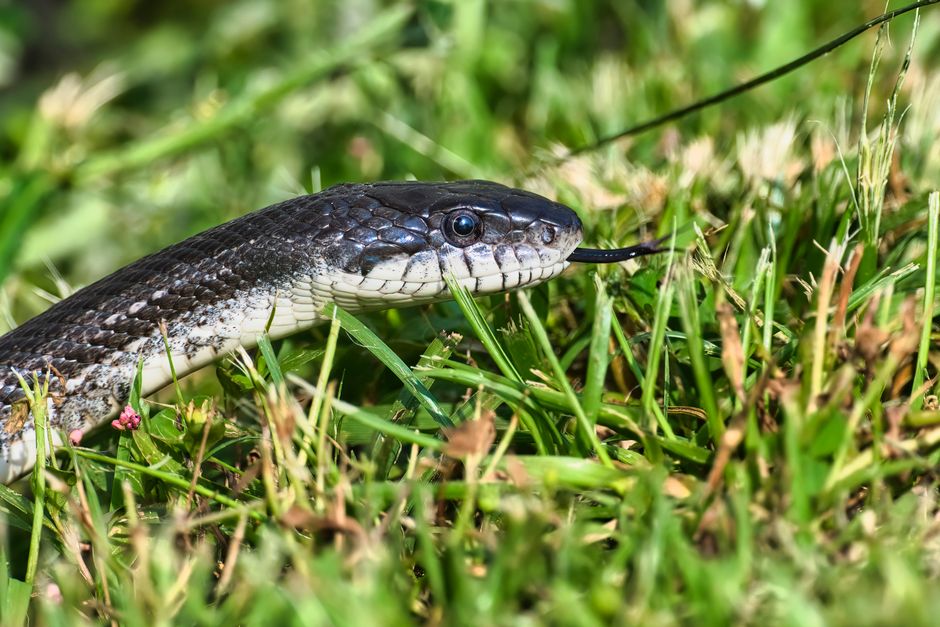
Pantherophis obsoletus
The Texas rat snake is one of the most commonly encountered large snakes in the state and a frequent visitor to barns, attics, chicken coops, and suburban yards. Adults typically reach 4 to 6 feet, making them one of Texas's longest snakes. Coloring varies regionally — usually yellow or orange with dark brown to black blotches on a lighter background — though West Texas individuals can look almost entirely black. These are powerful constrictors that eat rodents, birds, and eggs. Despite being harmless, they will vibrate their tail and strike if cornered. Found statewide in forests, farmlands, wetland edges, and even urban parks.
- Large — 4 to 6 feet long
- Dark blotches on yellow or tan background
- Slightly keeled scales, somewhat rectangular body cross-section
- No rattle, no pit, no triangular head
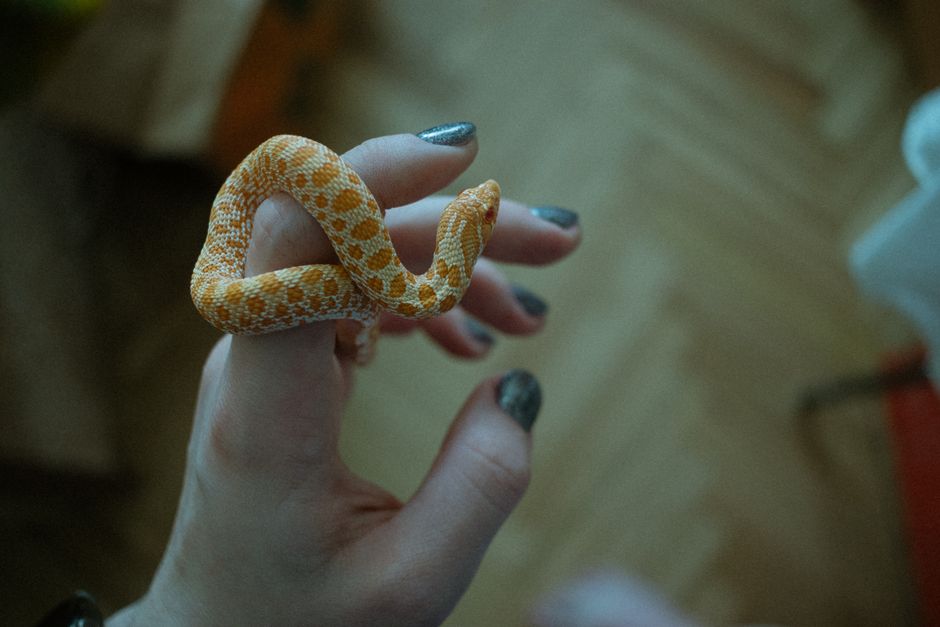
Heterodon platirhinos
The eastern hognose is a master of bluff and one of the most dramatic non-venomous snakes in Texas. Adults reach 20 to 33 inches and have a stout body with a distinctly upturned, shovel-like snout used for digging up toads. Coloring is highly variable — tan, brown, orange, or even black — with dark dorsal blotches. When threatened, hognoses flatten and spread their neck like a cobra, hiss loudly, and strike repeatedly — but almost never make contact. If the act fails, they flip onto their back and play dead convincingly. Found in East and Central Texas in sandy or loamy soils where amphibians are present.
- Distinctive upturned snout
- Spreads neck and hisses dramatically when threatened
- Stout body with variable blotched pattern
- Plays dead convincingly when pressed
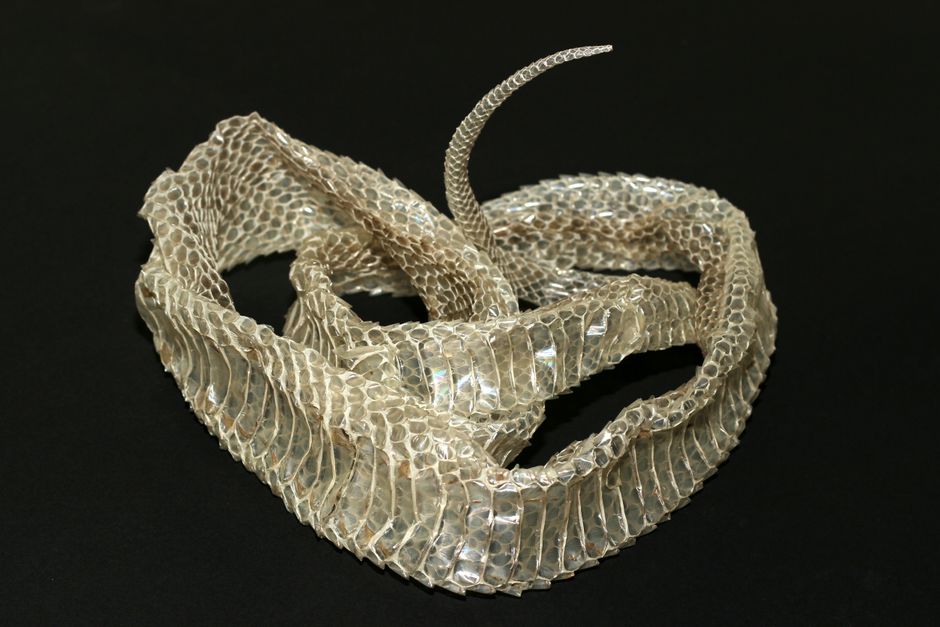
Opheodrys aestivus
The rough green snake is a slender, brilliant lime-green snake that is almost entirely arboreal, spending most of its time in shrubs, vines, and low tree branches near water. Adults measure 22 to 32 inches but are so thin they are easy to overlook among foliage. The belly is pale yellow or cream. Found throughout East and Central Texas in riparian corridors, garden hedges, and overgrown fence lines. Rough green snakes are completely harmless, feeding on insects, spiders, and caterpillars. They are gentle by nature and almost never bite, though they turn a dull blue-gray color after death — sometimes causing confusion for anyone finding a dead specimen.
- Vivid lime-green dorsal color
- Extremely slender body
- Pale cream or yellow belly
- Arboreal — found in shrubs and vines
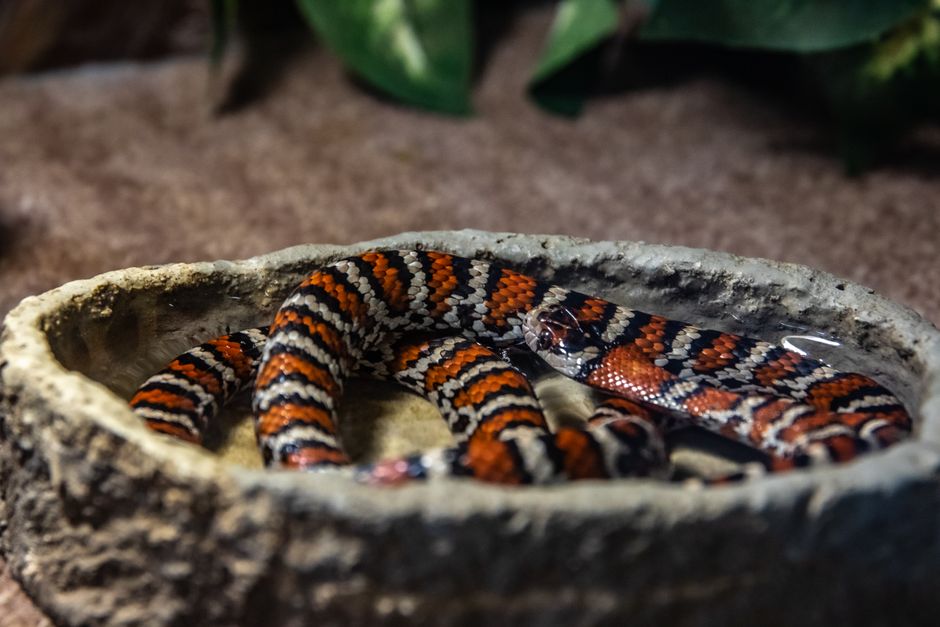
Lampropeltis elapsoides
The scarlet kingsnake is a small, beautifully patterned non-venomous species that closely mimics the Texas coral snake — a source of anxiety for many homeowners. Adults reach 14 to 20 inches. Like the coral snake, it has red, yellow, and black bands, but the key difference is that red bands touch black, not yellow — use the rhyme 'red touches yellow, kill a fellow; red touches black, friend of Jack.' The nose is red rather than black. Found in East Texas and along the Gulf Coast in moist forests, pine flatwoods, and under bark or logs. Despite its threatening appearance, it is completely harmless and actually benefits from being confused with its venomous model.
- Red bands touch black, not yellow
- Red-colored snout (not black)
- Small, slender — under 20 inches
- Smooth, glossy scales
How to Identify a Snake in Texas
The single most important field assessment you can do is look at head shape from a safe distance — ideally 6 feet or more. Texas pit vipers (rattlesnakes, copperheads, cottonmouths) all have a distinctly triangular head that is notably wider than the neck, giving it an arrowhead silhouette. Non-venomous snakes generally have a more oval or tapered head that blends smoothly into the neck. However, this rule has a significant caveat: harmless water snakes and hognose snakes can flatten and widen their heads when threatened, mimicking the venomous look. Never rely on head shape alone — use it as a starting point, not a final verdict.
Color pattern and body proportions give you the next layer of identification. Rattlesnakes are heavy-bodied relative to their length, with a segmented rattle at the tail tip. Copperheads have that unmistakable hourglass banding. Coral snakes have ringed coloring where red touches yellow. For non-venomous species, note the overall color, presence of blotches versus stripes versus rings, body width, and any distinctive behaviors. The pupil is sometimes cited as a field mark — elliptical in pit vipers, round in non-venomous species — but you should never get close enough to see a snake's pupil. If you're unsure, take a photo from a safe distance and use our AI snake identifier to get an instant species match.
- Always observe from at least 6 feet away — most bites happen when people try to handle or kill snakes at close range
- Look for the rattle first on any heavy-bodied snake in Texas — even a partial rattle or rattleless juvenile diamondback is still dangerous
- Use the coral snake rhyme: 'Red touches yellow, kill a fellow' — it works specifically for Texas species
- Check the setting: cottonmouths are almost always near water in East/Central Texas; coral snakes are rarely seen in open areas
- Take a photo rather than chasing the snake — a clear photo submitted to our AI snake identifier is worth more than a risky close-up look
Watch: In Their Natural Habitat
Video: Jari Lobo / Pexels
Safety: What to Do
- DO stop moving and calmly back away — most strikes happen when a snake is stepped on or cornered, not during a casual encounter
- DO keep children and pets well back and on a leash or in arms until the snake moves away on its own
- DON'T try to pick up, pin, kill, or relocate the snake yourself — the majority of venomous bites in Texas occur during attempted handling
- DO take a clear photo from a safe distance to help medical staff or our AI snake identifier confirm the species quickly
- DON'T assume a dead snake is safe — decapitated rattlesnakes retain bite reflex for up to an hour after death
- Call 911 or have someone drive you to the nearest emergency room immediately — do not wait for symptoms to develop, especially with coral snake bites where neurological effects can be delayed
- Keep the bitten limb at or slightly below heart level and immobilize it as much as possible during transport
- Remove rings, watches, and tight clothing from the bitten area before swelling begins
- Mark the edge of any swelling or redness with a pen and note the time, so ER staff can track venom spread
- Stay as calm as possible — elevated heart rate increases venom circulation through the lymphatic system
- Do NOT apply a tourniquet, do NOT cut and suck the wound, do NOT apply ice, and do NOT take ibuprofen or aspirin — all of these can worsen outcomes
- MYTH: Sucking out venom helps — it does not. Cutting and sucking is now firmly rejected by medical guidelines and can cause infection and tissue damage
- MYTH: A non-rattling snake is safe — juvenile rattlesnakes are born with venom but no full rattle, and copperheads never rattle at all
- MYTH: Harmless snakes have round pupils, venomous ones have slits — this requires dangerously close proximity and is unreliable in low light
- MYTH: You must catch or kill the snake to show the ER — a photo is sufficient and far safer; antivenom decisions are based on symptoms and regional species knowledge
This guide is informational, not medical advice. For any bite, seek professional medical care immediately — call 911 or Poison Control at 1-800-222-1222 (US). See also the CDC's venomous wildlife guidance.
Where Snakes Live in Texas
Texas's sheer ecological variety means snakes occupy nearly every environment in the state. Rocky hillsides and limestone outcrops in the Edwards Plateau are prime rattlesnake and copperhead country — these species use rock crevices for shelter and ambush prey along the edges. In East Texas, dense pine-oak forest floors covered in leaf litter harbor corn snakes, copperheads, and coral snakes. The Gulf Coast marshes and river bottomlands of Southeast Texas are the domain of cottonmouths and banded water snakes. The Trans-Pecos desert region supports a high diversity of rattlesnake species, including the Mojave and black-tailed rattlesnake, which are largely absent from central and eastern parts of the state.
Around homes and in suburbs, snakes are drawn to three things: food, water, and shelter. Woodpiles, rock gardens, dense ground cover, compost bins, and gaps beneath sheds provide ideal hiding spots. Bird feeders attract rodents, which in turn attract rat snakes and rattlesnakes. Swimming pools and ornamental ponds draw water snakes and, in eastern counties, cottonmouths. Reducing snake encounters around your property is largely about removing these attractants — stack firewood away from the house, keep grass mowed short, seal gaps in foundations, and reduce outdoor rodent activity. Snakes that appear in a yard are almost always passing through in search of food or a mate, not establishing a permanent residence.
When Snakes Are Most Active in Texas
Texas snakes are most active from March through October, with peak activity typically occurring in April through June and again in August through September as temperatures moderate slightly from summer highs. On very hot summer days — when ground temperatures exceed 95°F — most species go nocturnal or become inactive during midday, resuming movement at dusk. Warm spring nights after rain are particularly high-encounter periods, especially on rural roads where snakes bask on warm asphalt. In South Texas, where winters are mild, some species remain active year-round. In the Panhandle and Trans-Pecos, snakes brumate (the reptile equivalent of hibernation) from roughly November through February, sheltering communally in rock dens. A brief 'false spring' warm spell in winter can temporarily bring rattlesnakes out of their dens before temperatures drop again — a time when they are often sluggish and less likely to rattle before striking.
Frequently Asked Questions
The western diamondback rattlesnake (Crotalus atrox) is responsible for the most serious snakebites in Texas due to its wide distribution, large size, and potent hemotoxic venom. However, the Mojave rattlesnake found in the Trans-Pecos region produces a neurotoxic venom component that makes it potentially more medically complex bite-for-bite. All four venomous groups — rattlesnakes, copperheads, cottonmouths, and coral snakes — require emergency treatment.
Look at the head shape from a safe distance. Cottonmouths have a broad, blocky, distinctly triangular head with a thick neck and a pale-lined face stripe. Banded water snakes have a slimmer, more oval head and a narrower neck. The cottonmouth's threat display — gaping open to reveal a white mouth interior — is unique. When in doubt, stay back and take a photo for our AI snake identifier to confirm.
Yes, the Texas coral snake (Micrurus tener) is found across much of eastern, central, and southern Texas. It has red, yellow, and black bands that encircle the body, with red bands always adjacent to yellow bands. The entire head is black past a yellow collar. The rhyme 'red touches yellow, kill a fellow' applies accurately to Texas species. Its harmless mimic, the scarlet kingsnake, has red bands touching black instead.
You can, but only if you are confident the snake is non-venomous and you have the proper tools — a long-handled broom or snake hook to guide it into a bucket. Never attempt to handle a venomous snake yourself. For venomous species, contact a local wildlife removal professional or your county animal control. In most cases, leaving the snake alone is the safest option — the majority will move on within hours on their own.
During spring and fall, western diamondbacks and most rattlesnake species are active during daylight hours, especially in late morning and early afternoon when rock and ground temperatures are warm. In peak summer heat, they shift to crepuscular and nocturnal activity — most active around dusk, night, and early dawn. Be especially cautious hiking at dawn and dusk from April through September, and always use a headlamp on night hikes in rocky terrain.
Most snake species in Texas are not protected by state law, and killing them is technically legal in many circumstances. However, the Texas Parks and Wildlife Department discourages killing snakes, which are ecologically important predators of rodents and other pests. Some species, including the smooth green snake and certain region-specific species, have protected status. More practically, most bites occur during attempts to kill snakes — stepping away is both safer and better for the local ecosystem.
Treat a pet snakebite as an emergency. Keep the animal calm and carry it rather than letting it walk — exertion spreads venom faster. Call your veterinarian or an emergency animal clinic immediately and tell them you suspect a venomous snakebite. Dogs are bitten more frequently than cats, usually on the face or legs. Antivenom is available at many veterinary emergency clinics. Do not apply a tourniquet or attempt to treat the bite at home.
Of the 96 snake species found in Texas, 15 are considered venomous. These include 10 species of rattlesnake (western diamondback, timber, Mojave, black-tailed, rock rattlesnake, and others), 2 copperhead subspecies, the western cottonmouth, the Texas coral snake, and the western massasauga. The vast majority of Texas snakes are completely harmless, and even venomous species typically bite only in self-defense when handled or stepped on.